Your passive dosimeter is designed to measure the doses of ionizing radiation to which you are exposed during your professional activities. On this page, we explore the concept of passive dosimetry, dosimeters suitable for your exposure, as well as the various types of ionizing radiation, their measurement, and their effects on health.

 Individual dosimetry is the measurement of the dose received by an individual.
It can be of two types: internal or external.
For internal dosimetry, the source is located inside the body. It can occur after ingestion or inhalation of radionuclides. Measurement is carried out through the analysis of excreta (urine, feces, etc.), in vivo dosimetry, or through anthroporadiametry.
For external dosimetry, the source is located outside the body, resulting in irradiation. Measurement is done using dosimeters.
In the context of professional exposure, regulations require all classified workers entering monitored areas to wear at least a passive dosimeter.
The implementation of dosimetry is generally overseen by the Radiation Safety Officer (RSO) or the Radiation Protection Adviser (RPA) .

The personal dosimeter is worn:
The passive personal dosimeter is worn for a defined period (monthly or quarterly), depending on the nature and dose expected to be received.Please always follow the instructions of your Radiation Safety Officer (RSO) or Radiation Protection Adviser (RPA).
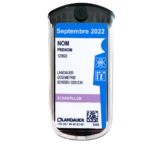
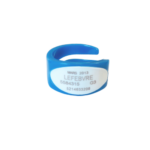
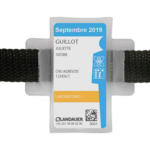
Outside of wear times, the dosimeter should be stored on a badge board outside regulated areas with the lowest possible background radiation. This location should always have a control dosimeter, clearly identified as such, which should never be worn under any circumstances.

The sievert represents the biological effect produced by a given absorbed physical dose on a living organism.
It is the unit of equivalent or effective dose.
The dose equivalent is not a directly measurable physical quantity but is obtained through calculation. It depends on the energy imparted to tissues, the type of radiation, and the tissue traversed.
One sievert is equivalent to one joule per kilogram.
[Sv] = J.kg⁻¹
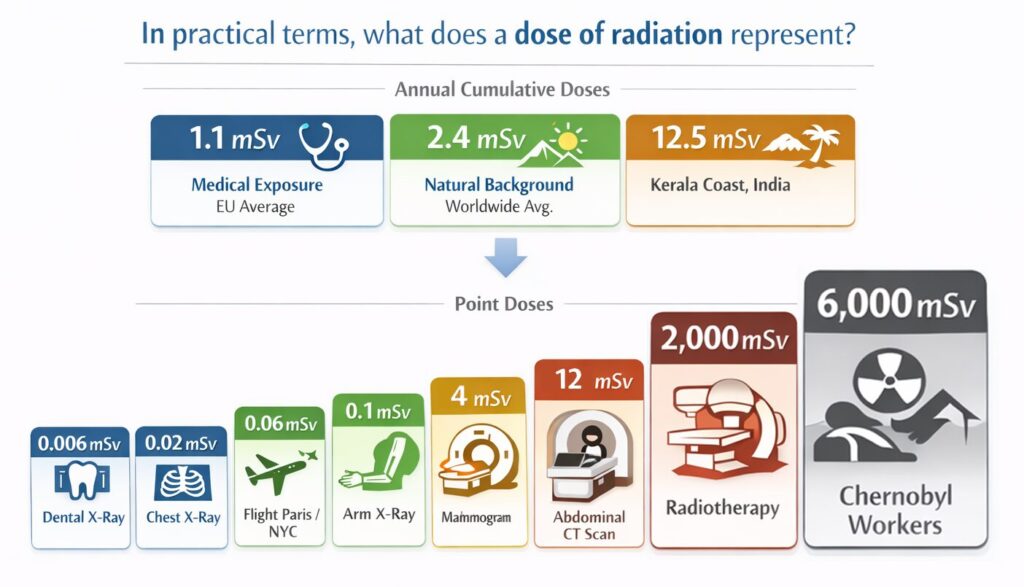
The dose transmitted by the dosimetry laboratory is expressed in sievert, for reference:
1 Sv = 1000 mSv = 1,000,000 µSv

There are many types of radiation, some visible and others invisible. Most of them are non-ionizing, such as radio waves, microwaves, and infrared radiation.
Radiation is considered ionizing when it is capable of removing electrons from matter. This includes, among others, ultraviolet, X-ray, or gamma-ray radiation.
To become more stable, a nucleus can emit various types of radiation: alpha, beta, gamma, and X-rays. These radiations are of different natures and do not have the same penetration power.
Learn more about :
The deterministic effects occur after exposure and may include symptoms such as nausea, vomiting, fatigue, and skin lesions (radiodermatitis). The onset of effects can range from hours to several months, or even years for cases of fibrosis or cataracts.
Stochastic effects may take years, or even decades, to manifest and can include cancers, cardiovascular diseases, and congenital malformations. They are more difficult to predict and attribute to exposure to ionizing radiation, especially in cases of low doses and over longer periods.
The impact of ionizing radiation on health depends on several factors, such as the dose of radiation received, the duration of exposure, the type of radiation, and individual sensitivity to radiation.
For annual cumulative doses:
For point doses: